
Why I Quit My Academic Job to Study Photography
People often imagine life-changing career decisions as a single dramatic moment: a sudden epiphany, a bold declaration, a clean break. My decision to quit my academic job and step away from my work in artificial intelligence training was nothing like that.
The truth is that the moment had been building for years.
It started as a quiet, persistent feeling – something niggling at the edges of my consciousness. A sense that something wasn’t quite right. That despite professional success, despite recognition, despite doing work that many people would consider exciting and meaningful, I wasn’t entirely being true to myself.
For a long time, I ignored it.
Then the feeling began to show up in ways I could no longer dismiss. My commute to work became increasingly difficult. I would get closer to the campus and feel my chest tighten. The panic attacks started small, but they became more severe the closer I got to my office.
Eventually I had to face what my body had already realised: something had to change.
I want to be clear about something here. The organisation I worked for was incredibly hard to fault. It had a supportive culture, systems that worked, and leadership that genuinely wanted staff to succeed. I had a private office, stability, and a clear pathway to promotion. On paper, it was the kind of job people aspire to.
But something had shifted for me.
Teaching, once the thing that energised me most, was becoming increasingly difficult. I would walk into classrooms where many students hadn’t prepared for the topic of the week and seemed more engaged with their phones than the subject matter. I was trying to be in service of their learning, but increasingly I felt like I was performing to a room that didn’t want to be there.
Eventually I had to ask myself that same uncomfortable question: Why was I there?
At the time, there was another contradiction unfolding. I was thinking about leaving academia during what many people would consider the peak moment of opportunity for someone working at the intersection of entrepreneurship and artificial intelligence.
Thanks largely to timing, sharing everything I was learning about AI, and a real-world problem that needed solving within the higher education sector, I found myself riding the AI wave like a rocket ship.
And yet, the question people kept asking was the same: Why leave now?
Part of the answer lies in the work I was doing around AI training and education. I spent a lot of time running workshops and delivering sessions designed to help academics develop AI skills. Most of the people in those sessions were thoughtful, enthusiastic, and curious, and a joy to spend an afternoon in a room with.
But increasingly I also encountered something else.
Resistance.
In many cases the strongest pushback came from people who had barely used AI tools at all. Yet their opposition was often forceful and, at times, directed not just at the technology but at the people teaching about it. Which meant, inevitably, directed at me.
After several training sessions where the atmosphere in the room felt noticeably hostile, I began to recognise the toll it was taking. The tension, the defensiveness, the sense of being under attack simply for sharing knowledge.
Eventually I had to acknowledge a difficult truth: the harm this was doing to my mental health and wellbeing outweighed the benefits of continuing the mission I had set for myself – to help uplift the sector through AI literacy.
That realisation opened the door to a bigger question.
If not this… then what?
The AI Paradox
When ChatGPT was released, my life changed overnight.
Like many researchers and educators, I became deeply immersed in understanding what these tools could do. My research accelerated. My training programmes expanded. I wrote constantly – blog posts, resources, guides, reflections – sharing everything I was learning with the academic community.
For a while, it was exhilarating.
But slowly something unexpected began to happen.
The very tools that were helping me work faster also started to erode the joy I once felt in writing and research. I would sit down to draft an article or explore an idea and find myself thinking:
What’s the point, when an AI chatbot can ostensibly produce something similar in seconds?
Of course, the reality is more nuanced than that. AI cannot replace genuine intellectual inquiry, lived experience, or original thinking. But psychologically, the presence of these tools began to change how the work felt.
AI had started to steal my joy for research.
It wasn’t just that. The pace of change in the AI world is relentless. Every day there seemed to be a new model, a new tool, a new announcement. To stay current meant constantly reading, watching, experimenting, analysing.
I found myself spending extraordinary amounts of time staring at screens.
Late nights watching product demos. Hours disappearing down YouTube rabbit holes. Endless streams of commentary, predictions, and debates about the future of work and knowledge.
The irony was hard to ignore.
For someone who had always loved making things – working with my hands, being out in the world, creating tangible objects – I was building a professional life that kept me almost entirely inside a digital environment.
Something important was missing.
Healing Through Creative Practice
When I finally acknowledged that I was burnt out (a self-diagnosis, based on having completed my PhD on the topic of burnout so the signs were hard to miss), I wasn’t immediately ready to make a radical life decision.
Walking away from a stable academic career is not something you do lightly.
Instead, I started doing something small.
I picked up a camera. Not a phone with a camera, but a single function device dedicated to making images.
At first it was simply a form of escape.
After long days spent in front of screens, teaching, or delivering AI sessions, I would walk the streets of whichever city I was in late into the night with my camera. No laptop. No notifications. No algorithms shaping my attention.
Just me and a camera.
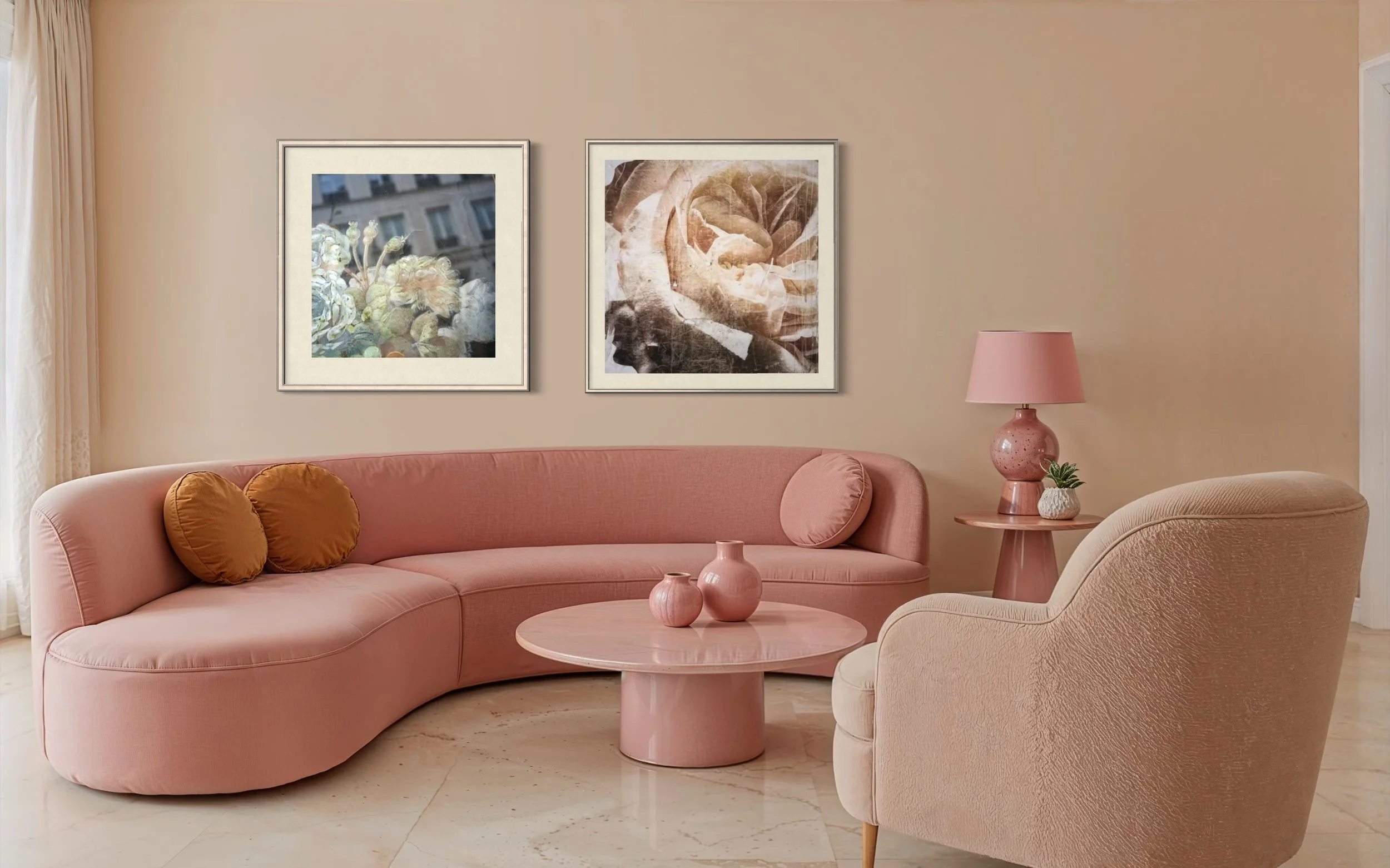
Examples of my photographic prints, framed images made on the streets of Paris
I began noticing things again. The way light hit a building at a certain hour. The quiet choreography of pedestrians at a tram stop. The small traces of human life embedded in urban spaces – stickers on traffic lights, worn paint on doorways, discarded objects that hinted at unseen stories.
Photography reminded me that creativity doesn’t always mean producing something quickly. Sometimes it means learning how to see.
The contrast with my AI work was stark.
AI exists in a world of abstraction – data, models, probabilities, digital outputs.
Photography, by contrast, is embodied. You move through physical space. You respond to light, time, weather, and chance.
It didn’t feel rushed.
What began as a form of therapy slowly became something deeper. Photography wasn’t just helping me escape the digital world – it was reconnecting me to a different way of thinking and feeling.
Even though I was using a digital camera, it was a form of digital interaction that felt untethered from the noise of the internet.
Why Photography Became the Right Next Step
The more time I spent making photographs, the more I realised what had been missing from my life.
Slowness. What feels increasingly like a privilege: the ability to be offline.
In a world accelerating with AI, photography invited me to slow down. To observe. To wait for the right moment rather than forcing productivity.
It also brought me back to creativity in its most direct form.
Academic work is creative in many ways, but it is also mediated through systems: publication metrics, institutional expectations, peer review processes. Photography, by contrast, allowed me to create something immediate and personal.
There was also another unexpected joy: being a beginner again.
Leaving Academia
Leaving academia is not just about leaving a job. It is about leaving an identity.
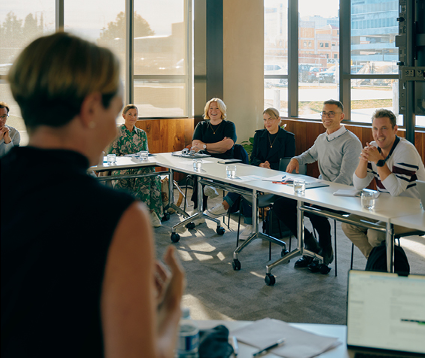
Delivering AI training at The University of Tasmania
For years, when people asked me what I did, I replied: “I’m an academic”. That phrase carries a certain weight. It signals expertise, education, stability. People tend to respond with interest or respect.
Compare that to saying: “I’m an artist studying photography”.
The reaction I get is very different. There is a subtle but undeniable reduction in reputational cache that comes with choosing a creative path. Although this admittedly depends on the audience.
Do I regret the decision?
Honestly, there are days when I miss the wage.
Financial security is a powerful comfort, and academia provided that. But something else has replaced it.
I now wake up every day excited about the future.
My mind is full of creative ideas – projects, experiments, images I want to make. I still conduct research, but now it happens on my own terms, driven by curiosity rather than institutional pressure. That shift has been profoundly energising.
Academia is still very much within me and I’m not writing off the possibility that one day I’ll return to the front of a classroom. Should that day come, I envision it to be within an arts-based context. For now, I’m focusing on embracing being a student and redesigning my life through the creative process.
Studying Photography as a Beginner
Once I decided to pursue photography seriously, I approached the decision the way any academic would: through research.
I spent months investigating photography programmes, comparing course structures, faculty expertise, and learning environments. Eventually I decided to enrol in a Bachelor of Photography at RMIT.
The choice felt natural.
I worked as a Senior Lecturer at RMIT, still hold an adjunct role, and feel a strong connection to the institution. The campus environment is vibrant and creative, and the photography program is widely regarded as one of the best in Australia.
Still, returning to the classroom as a student has been an unusual experience.
For years I stood at the front of lecture theatres. Now I sit in them. Albeit in the front rows (which seems to attract most of the mature-age students).
It is slightly surreal to be on the other side of the educational dynamic – taking notes, submitting assignments, waiting for feedback.
Being a mature-age student also has significant advantages.
Mature-age students can bring decades of lived experience into their work. Having a background in research shapes how I approach assignments and creative photographic projects. In many ways, it feels like the perfect moment in my life to be learning this craft and I doubt whether I would have approached my learning with the same vigour if I was two decades younger.
What AI Taught Me About Photography
Ironically, my background in AI has profoundly shaped how I think about photography.
Working with artificial intelligence forces you to confront big questions about creativity. What does it mean to create something original? Where does authorship lie when algorithms are involved? What makes human perception unique?
These questions become especially interesting in the age of generative images.
AI can now produce highly convincing pictures from simple text prompts. Entire visual worlds can be synthesised in seconds.
So why does photography still matter?
For me, the answer lies in presence.
Photography is not just about the final image – it is about the act of being there. Standing in a particular place at a particular moment in time. Responding to real light, real environments, real human traces.
AI images may be visually impressive, but they are fundamentally detached from lived experience.
My research mindset also continues to shape my artistic practice. In that sense, my past career has not disappeared.
It has simply evolved.
What I’m Learning Now
Photography is teaching me many things.
One of the most important is the difference between looking and seeing.
Looking is passive. Seeing requires attention.
I am also learning to slow down; patience. Light changes constantly. Scenes evolve. Sometimes the best photograph emerges only after waiting quietly for the right moment.
Photography also encourages embracing imperfection.
Not every frame will work. Not every idea will succeed. But the process of experimentation is where the most interesting discoveries happen.
Above all, photography is teaching me the value of attention.
In a world saturated with images and information, attention has become a rare and powerful resource. The act of carefully observing the world – of noticing small details that others might overlook – feels almost radical.
Quitting AI and Academia??
From the outside, my decision might look like a dramatic break.
Quitting AI. Leaving academia. Starting over in photography.
But the reality is more nuanced.
I haven’t abandoned AI or research entirely. Instead, I have reframed how I interact with them. They are no longer the centre of my professional identity, but they remain tools and perspectives that inform my thinking.
What this decision really represents is something simpler.
It is about honouring the creative part of myself that had been quietly asking for attention for years.
I didn’t want to reach retirement age and realise that I had never given that side of my life the chance it deserved.
So, for better or for worse, I took the leap.
Not because it was the safest option, or the most logical career move, but because it felt true.
For me, and maybe also for you, that is reason enough.
